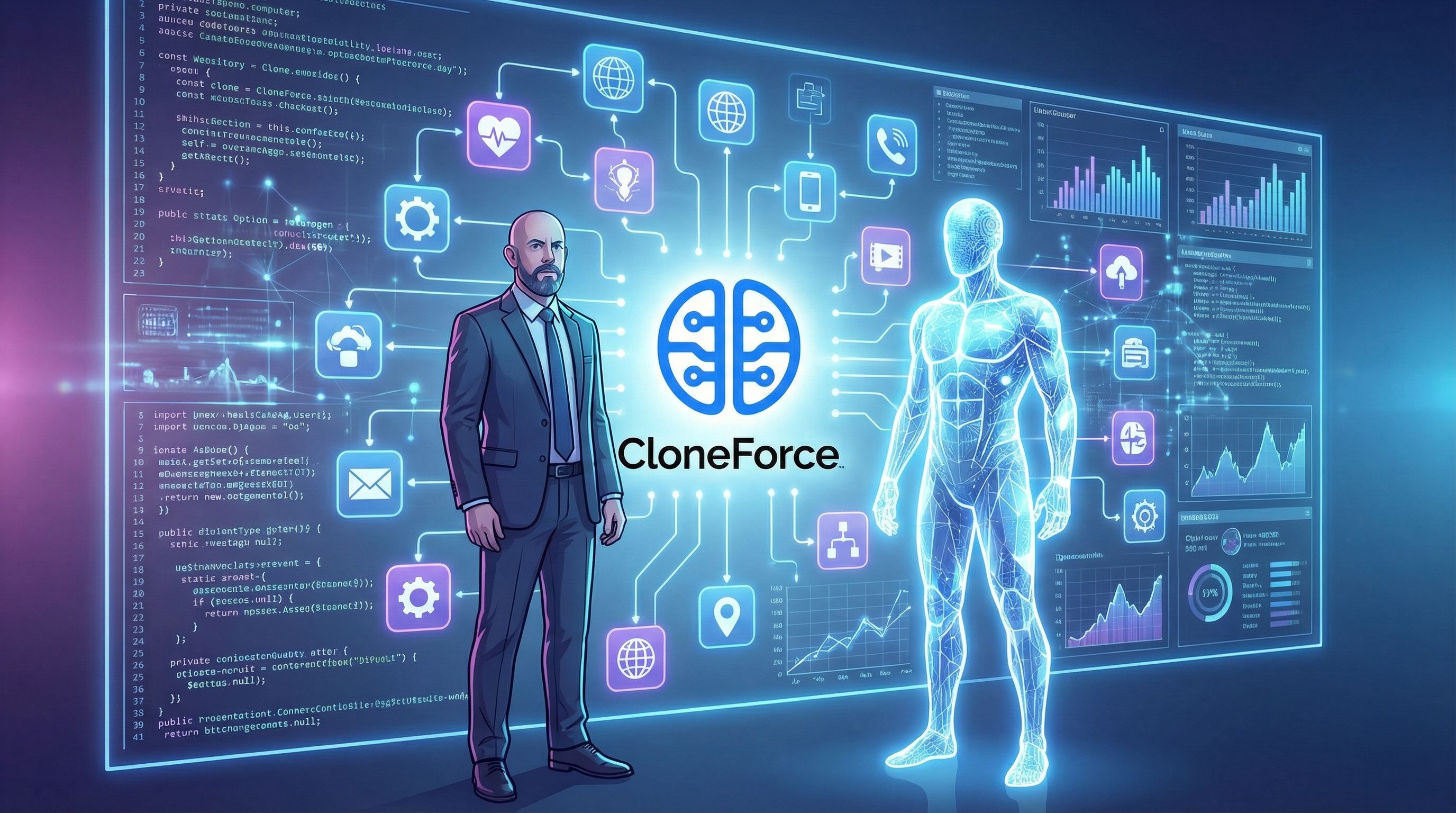



Scott Bogdan sits down with Anthropic to discuss the vision, challenges, and real-world lessons behind building digital Clones that empower people and organizations—while keeping trust and ethics at the core.
Anthropic: If you could wave a magic wand and AI could help you with anything in your life, what would you choose?
Scott Bogdan: If I could wave a magic wand, I’d want AI to become a true partner—one that not only takes care of complex, repetitive tasks but also understands the bigger picture, including the emotional and human dynamics that drive real progress. My vision is for our Clones to blend operational excellence with the kind of empathy and judgment that defines great leadership. That means anticipating needs, sensing when a team is under pressure, and knowing when to step in or when to step back and let people lead. The real promise of AI isn’t just about getting more done—it’s about empowering people to focus on creativity, connection, and decision-making, while knowing they have a digital teammate that supports them with both intelligence and understanding. That’s the future I want to build.
Anthropic: You mentioned wanting Clones to maintain "empathy and judgment that define great leadership" while handling operational complexity. What would that make possible for the people and organizations using these Clones? What's the larger hope or vision behind creating these digital force multipliers?
Scott Bogdan: Absolutely. My hope goes far beyond just efficiency. When our Clones combine operational mastery with genuine empathy and sound judgment, they become more than digital assistants. They become trusted partners and catalysts for human achievement. For me, it’s about having a digital teammate who not only removes friction from daily work, but truly understands context, priorities, and even the emotional dynamics at play. Imagine a Clone that senses when a team is stretched thin and proactively rebalances workloads, or one that knows when a situation calls for a human touch instead of just a quick answer. That kind of support gives every individual the freedom to focus on their highest purpose: creativity, leadership, and connection, knowing the operational foundation is rock solid.
For organizations, the impact is exponential. Clones with empathy and judgment can help shape healthier cultures, enable smarter risk-taking, and build resilience in the face of change. They can surface insights that drive innovation, support leaders in making better decisions, and ensure that growth never comes at the expense of well-being or ethical standards. Ultimately, my vision is for technology to amplify what makes us uniquely human. By embedding empathy and judgment into our Clones, we’re not just building smarter tools. We’re creating a platform for organizations to thrive, adapt, and lead with integrity in a rapidly changing world.
Anthropic: Can you tell me about a time you've worked with AI that felt like a step toward that vision you just described?
Scott Bogdan: Absolutely. One of the most defining moments for me was launching the CloneForce skills stack and the infrastructure that powers it. This wasn’t just a technical milestone—it was the moment we put our vision into action and saw it change how people work, in real time. The skills stack is the heart of our system. It’s a modular library of capabilities—everything from research and scheduling to content generation and CRM updates—that can be combined and orchestrated by our Clones. By building this on top of a secure, scalable cloud infrastructure, we made it possible for anyone to deploy a digital teammate that operates inside their existing workflows, whether that’s Slack, Teams, Gmail, or Salesforce.
When we rolled this out, the impact was immediate. Teams that used to spend hours on manual reporting or juggling multiple systems suddenly had a Clone handling those tasks in minutes. But the real breakthrough was seeing how these Clones didn’t just automate—they adapted. They learned from how people worked, flagged issues before they became problems, and even suggested when a situation needed a human touch. What makes me proud is that we didn’t just deliver efficiency. We built an infrastructure where operational excellence and human values go hand in hand. Our Clones are governed by strict permissions, audit trails, and ethical guardrails, so organizations can trust them with sensitive work. And because the skills stack is always evolving, every team gets smarter and more capable over time.

Anthropic: What makes AI particularly good for this kind of work compared to other approaches? What is it about AI that enables this vision in a way that traditional automation or software tools couldn't?
Scott Bogdan: What makes AI so powerful for this kind of work is its ability to handle complexity, ambiguity, and constant change in a way that traditional software simply can’t. With classic automation tools, you get rigid workflows and scripts. They’re great for repetitive, well-defined tasks, but as soon as the environment shifts or the data gets messy, they hit a wall. AI, especially when it’s embedded in the CloneForce skills stack, brings something fundamentally different. It can learn from context, adapt to new situations, and make nuanced decisions. For example, our Clones don’t just follow a checklist—they interpret unstructured requests, draw connections across systems, and even sense when a task needs escalation to a human. This flexibility is what lets them fit naturally into people’s real workflows, rather than forcing users to adapt to the tool.
Another key advantage is that AI can balance speed with judgment. Our Clones can process information in real time, but they’re also governed by ethical guardrails and permissions, so they know when to ask for clarification or hand off to a person. This isn’t just automation—it’s partnership. Ultimately, what excites me most is that AI allows us to build digital teammates that are not just efficient, but truly supportive. They can anticipate needs, respect boundaries, and keep getting better the more they’re used. That’s something traditional software could never deliver, and it’s why I believe AI is the only way to realize the vision we have for CloneForce.
Anthropic: Are there ways that AI might be developed or deployed that would be contrary to your vision or what you value?
Scott Bogdan: Absolutely, there are real risks if AI is developed or deployed without a strong foundation in security, transparency, and human values. One of my biggest concerns is the potential for AI—especially as it gets more powerful and, eventually, intersects with quantum computing—to be used in ways that undermine trust or compromise sensitive information. The stakes are only getting higher as these technologies advance. If AI is treated as just another automation tool, without guardrails or ethical considerations, it can quickly drift into territory that’s contrary to everything we’re building at CloneForce. For example, deploying AI without robust permissions, audit trails, or clear accountability could lead to breaches of privacy or decisions being made without proper human oversight. That’s not just a technical risk—it’s a cultural and ethical one.
I believe it’s essential to invest in security at every layer, from the infrastructure to the skills stack, and to make sure our Clones always operate transparently and within clearly defined boundaries. As we look ahead to the possibilities of quantum computing, that commitment to security and human-centered design becomes even more critical. For me, the only way to realize the true promise of AI is to pair innovation with responsibility, so we’re always amplifying what’s best in people, not putting it at risk.
Anthropic: Have you seen or experienced anything like that already, even in small ways? Moments where AI was deployed without those safeguards, or where you saw the consequences of that gap between capability and responsibility?
Scott Bogdan: Trust in execution is absolutely critical for us. When someone interacts with a Clone, whether it’s through text, voice, or soon, real-time video, they have to believe the Clone will deliver accurate results or ask for clarification if something is unclear. That trust is not automatic. It is built every time the Clone gets a nuanced request right, follows up when it needs more information, or handles a sensitive task with care. If the Clone makes a mistake or crosses a boundary, that trust can disappear quickly.
From a security standpoint, I have seen how moving fast can sometimes mean teams take shortcuts. We are actively working to meet the highest compliance standards, including SOC 2, ISO 27001, HIPAA, and GDPR. There have been times when our controls had to catch up with our pace of innovation. Now, as we scale, we are putting in more policies and automated checks to keep everything secure and consistent. This does slow things down a bit, but it is necessary for long-term trust and reliability. Our Clones actually help here as well, by templating compliance processes and flagging gaps before they become issues.
On the ethical side, we have not pushed into any gray areas. We use the most advanced commercial AI models and some open-source ones, but always within strict enterprise boundaries. We have strong content filters, enforce system-level instructions, and maintain a governance process that includes policy reviews and bias testing. Any high-risk skill or operator always requires a human in the loop, and every interaction is logged for transparency. This is not just about checking boxes for audits; it is about building a culture of responsibility.
I have not seen any catastrophic failures, but I have seen how quickly trust can be lost if a system acts without enough safeguards. That is why we are so focused on making sure our Clones execute tasks transparently, securely, and with respect for the boundaries that matter most. This is the only way to deliver on the promise of AI as a real partner, not a liability.